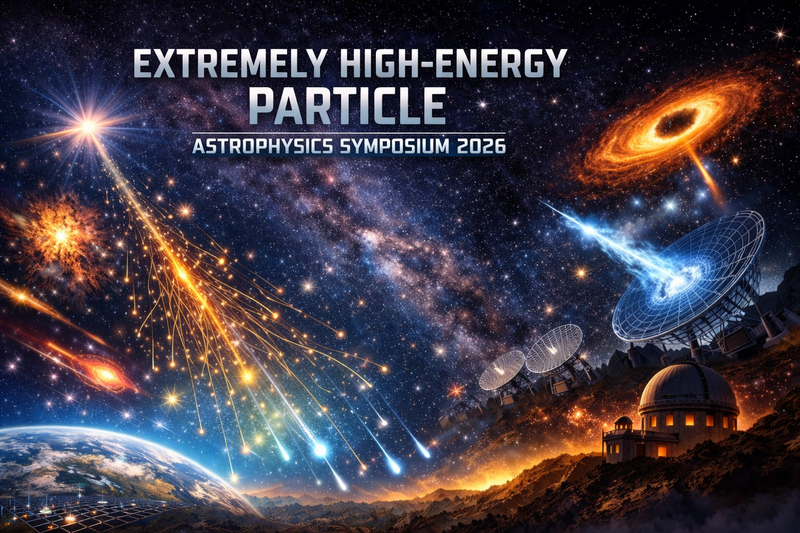
Neutrinos offer a uniquely powerful way of observing the Universe: able to escape from the densest regions in nature and travel across cosmic distances unhindered and undeflected by magnetic fields, they carry unaltered information about the most extreme phenomena in the cosmos. Over the past decades, neutrino astronomy has achieved remarkable milestones—from the discovery of solar and supernova neutrinos to the establishment of neutrino oscillations and a deeper understanding of weak interactions in astrophysical environments.
More recently, the detection of high-energy astrophysical neutrinos has transformed the frontier of particle astrophysics at the highest energies. These advances are opening new insights into the most extreme accelerators in nature and into the physical conditions that govern particle acceleration and propagation across cosmic distances. Neutrinos have become a cornerstone of multimessenger astronomy, a new frontier in which multiple cosmic messengers are combined to provide complementary and interconnected views of astrophysical phenomena. In particular, increasingly precise observations of ultra-high-energy cosmic rays (UHECRs) have sharpened key questions: the identity of extreme sources, the maximum achievable energies, the composition at the highest energies, and the role of magnetic fields and backgrounds in shaping what we observe at Earth. In parallel, high-energy neutrinos provide a unique probe of hadronic processes in dense and energetic environments, pointing directly to sites where cosmic rays interact and produce pions. Together, multimessenger observations offer deeply connected perspectives on the highest-energy Universe.
This symposium will bring together experts in multimessenger astrophysics to discuss lessons from the past, the status of our current understanding, open problems, and future opportunities—from source modeling and multimessenger consistency tests to next-generation detectors and observatories. In doing so, we will celebrate the 60th anniversary of Shigeru Yoshida, whose contributions have fundamentally advanced this field.
Important dates:
Registration deadline : 2026-XX-DD
Poster presentations deadline : 2026-XX-DD